
Definition
A Dream Team is a group of people that add up to more than the sum of their parts.
The Dream Teams Leadership Framework In a Nutshell
For a team to become more than the sum of its parts, it needs different ways of thinking to smash together in the right ways, and people need to be willing to change.
By mathematical definition, a group of people who think similarly can only be as smart as the smartest (or most powerful) person in the group. Therefore, teams often are limited in their problem-solving by whoever is in charge.
A team that makes breakthroughs—one that can think of things that no one of its members could on its own—has three components: Cognitive Diversity, Cognitive Friction, and Intellectual Humility.
Here’s how it breaks down:
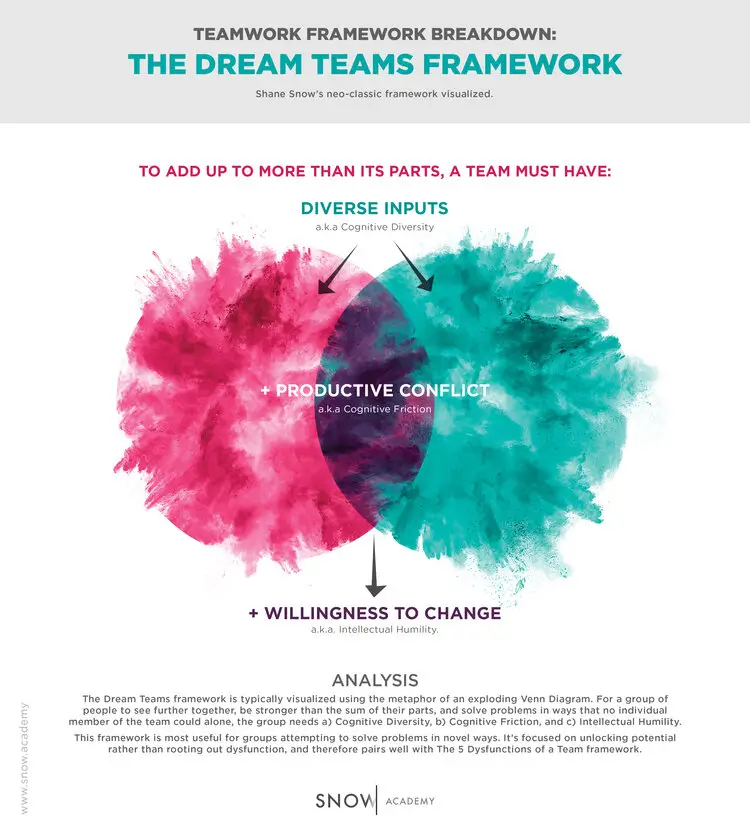
The framework consists of three main components. Each of them suggests a set of skills and habits for maximizing a team’s potential:
1) Cognitive Diversity
In order to see further together and become more than the sum of its parts, a group must have different mental ingredients—a.k.a Cognitive Diversity. Thus, the following skills and practices are essential to making use of cognitive diversity and creating the groundwork for a high-potential team:
- “Casting,” or gathering people who think differently in useful ways. I.e. Identifying and recruiting people with diverse perspectives and heuristics.
- Seeking “culture add” over “culture fit.” I.e. Making sure team members know their different ways of thinking are valued, and they are not expected to conform to a given way of thinking or doing things.
- Decoupling progress from correctness. Celebrating people for contributing and pushing the group forward, not just for being right.
2) Cognitive Friction
To be useful rather than inert, different ways of thinking must smash together in productive conflict. In psychology terms, this is called Cognitive Friction. The key skills that help a team do this well include the following:
- Practicing productive debate, where the goal is to explore ideas together rather than “win.”
- Becoming comfortable exploring all points of view to find their merits or useful analogies—including outrageous lines of thinking. Even seeking out ideas and experiences that push you out of your usual zone of thinking.
- Becoming comfortable with and inviting disagreement. Creating an environment where dissent and pushback are appreciated rather than discouraged.
- Defusing tension through play, humor, and pulling conflict back from the ledge when things start to get personal.
3) Intellectual Humility
Finally, team members must be willing to change their minds in light of the cognitive conflict—using what’s called Intellectual Humility. Therefore the following skills and habits become linchpins for actually making use of the diversity and productive tension in a group:
- Radical curiosity—modeling a willingness to listen to people and ideas (even ones that others refuse to humor) before making a judgment call. This is about the wisdom of gathering information before coming to conclusions.
- Empathy-building, through storytelling, traveling, and learning about other cultures.
- Perspective-taking, or putting yourself on the other sides of stories and debates.
- Depersonalizing conflict and ideas—a.k.a. separating ego from intellect. In other words, preventing debates about ideas from becoming about identity, and separating the source of an idea from the validity of an idea itself.
- Overcoming intellectual overconfidence, and recognizing that what got you here may not get you to the next level.
- Being willing to revise views and strategies even when it’s hard. This kind of flexibility and adaptability is the ultimate mark of a high-potential team (and leader).
The Dream Teams framework explains how teams can solve problems in novel ways and continually improve and adapt. It’s most effective for teams with a specific desire for innovation.