
RESEARCH & NOTES
A Short Guide to The Team of Teams Framework

Explorations > Teamwork > the team of teams framework
The Team of Teams framework was created by General Stanley McCrystal's consulting group in 2015. The framework came about from McCrystal's work in the U.S. Military as the challenges of battle shifted and required more resilience and adaptability than the typical command-and-control style of military leadership allowed.
The Team of Teams Framework in a nutshell
super simple summary:
To solve tomorrow’s challenges, team leaders need to share more information and let let team members make more decisions.
Detailed explanation:
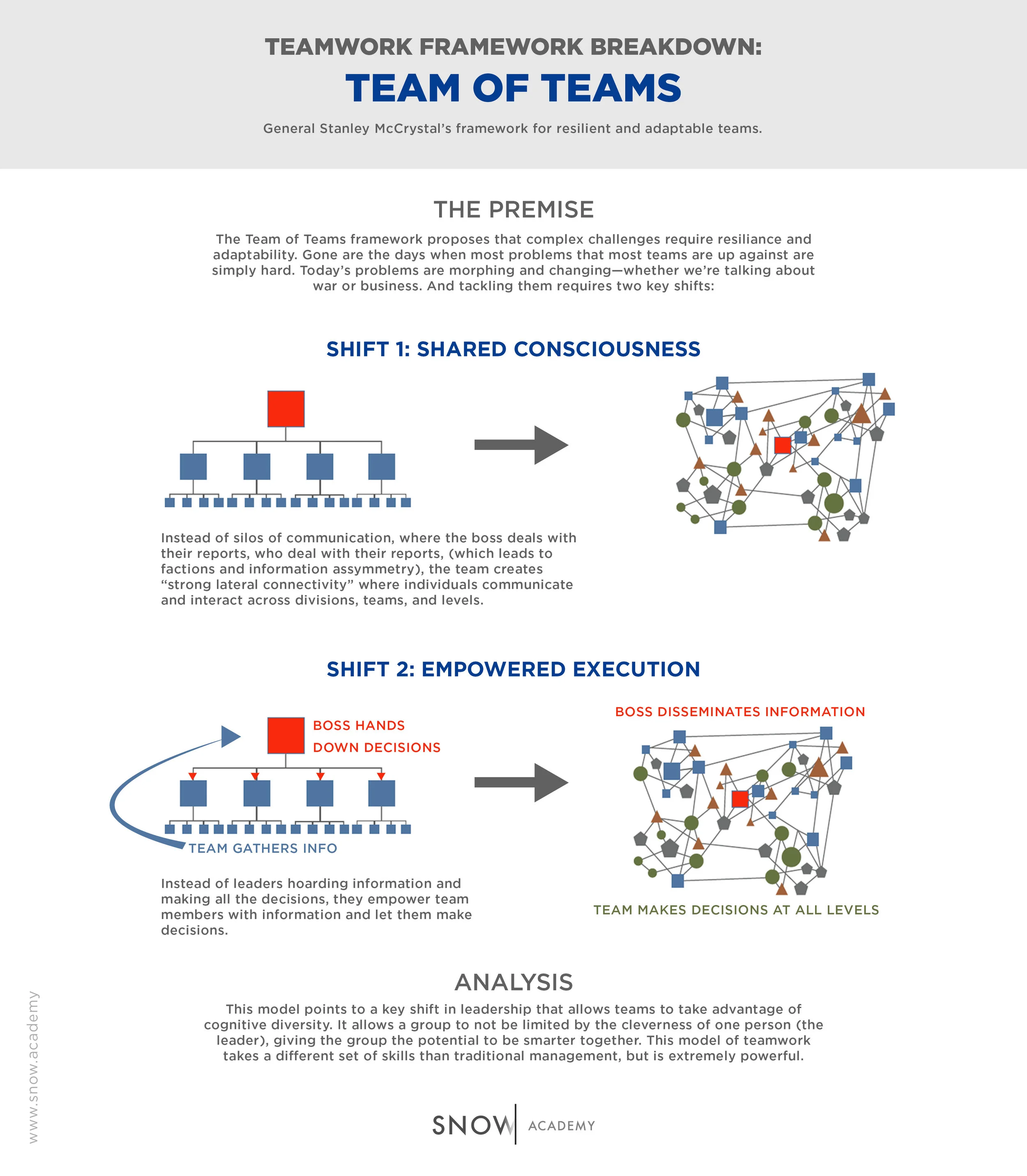
This framework basically says that the teams of tomorrow need to be more resilient and flexible than before, and to do that, we need to flip two things around:
-
Move from silos of information to “shared consciousness.” Instead of only communicating through the chain of command, team members should have lots of interactions with other team members from all over.
The spread of information and understanding is key to good decision-making. And this necessitates a letting go of control, which brings us to the next shift:
-
Move from a leader making all the decisions to a leader empowering people with information so they can make decisions.
Traditionally, the chain of command structure allowed a leader to gather information from the troops, so they could make decisions and hand them down. The Team of Teams model flips this upside down:

What’s The Team of Teams Framework Most effective for?
This model is an excellent high-level philosophy for creating teams that do not have a single point of failure (a leader who can be wrong, or get hit by a bus), and that have a high chance of good decision making. I recommend this as a philosophy from which to start building a productive team culture.
What’s it less effective for?
This framework is not a very good model for teams who have unskilled or low-trained members. Being given freedom + responsibility is great if you have a basic level of confidence in your skills. That’s why this model works well for military and white collar organizations—there’s a good amount of training already in place at all levels.
It’s also not a very prescriptive model outside of its two main mindset shifts. For more help on how to make a well-organized team of teams smart and productive, I suggest starting with The Dream Teams Framework.
Recommendations for using This framework:
The principles of the Team of Teams framework is an excellent starting point for team culture. Use it as a guide for your communication and information philosophy if your organization can handle it, and your team members will feel empowered, trusted, and (hopefully) grateful.
Recommended further resources:
-
The Ultimate Guide to Trust in Teams
-
Shifting From Hero Leadership To Conductor Leadership
-
Intellectual Humility: The Ultimate Guide

For more on maximizing your teamwork productivity: Check out the Snow Academy course on The Skills of Dream Teams!


![Universal Principles For Better Teamwork [Infography]](https://cdn.prod.website-files.com/6977cdf91b227f93236c1cf7/69a8dd4a21fe9822a5e5f968_sebastien-bonneval-1AEx2Voy8cI-unsplash.jpeg)